Ceiling Problems in Middlesboro Homes
A ceiling signals trouble in only a few ways, and each one points somewhere different: a leak, a fastener, the roof structure or simply age. This guide takes them one at a time, with notes on how the city's housing stock, from founding-era plaster to houses finished from 2000 onward, changes what each sign means.
Stains: rings, tide marks and yellowing
A brown blotch outlined by a deeper brown edge marks water that soaked in and then dried, carrying tannins from wood and dust to the surface. A stain under a bathroom usually traces to a tub or shower seal; one by an exterior wall or a chimney tends to be roof flashing; one in the middle of a top-floor ceiling, especially in summer, can be an attic air conditioner's condensate line. Middlesboro's humid subtropical summers keep those units running for months, so a clogged drain is worth ruling out early.
When the marked area stays solid and reads dry, sealing it with stain-blocking primer and repainting often does the job. If it is soft, crumbles at a touch or reads wet on a meter, that piece of ceiling is removed and renewed. The related ceiling leak repair page lays out the sequence.
Sagging: when a ceiling starts to drop
A ceiling that dips in the middle has either taken on water or let go of the joists. Water-loaded gypsum can bulge suddenly and fail, so if you see a bulge, deal with electricity before anything else: switch off whatever circuit runs that ceiling's light or fan. Next, clear everyone from under the bulge and put a bucket where it drips.
A dry sag is different. In older plaster ceilings it means the plaster has broken free of the lath across a wide area; in drywall it usually means screws set too sparsely or board too thin for the joist spacing. Both are fixed by securing or replacing the section, never by pushing it back up and painting.
Truss uplift: a winter seam that reopens
Some 816 homes standing in Middlesboro today went up in 2000 or later, per Census tables, and plenty of houses that new sit under trussed roofs. When winter air chills the top of a truss while its bottom chord stays warm in the insulation, the truss arches upward and pulls the ceiling's edge up off the partition walls, opening a straight crack at the corner. By summer it may close again.
Taping that corner tighter only tears again. The proper fix unfastens the ceiling board along the partition's upper framing, holds its edge with drywall clips, and finishes the corner with a flexible bead or trim so the ceiling can move without cracking.
Popcorn texture: the 1970s finish
The 1970s are the largest single decade among homes standing in Middlesboro today, 671 of them in Census tables, and spray-on acoustic texture was a common ceiling finish in that period. It traps dust, stains easily and comes loose when wet. Finishes of that vintage may hold asbestos, so have a chip analyzed by a lab ahead of any work on it. After that, a damaged patch can be resprayed, or the whole ceiling scraped and skimmed smooth.
Seam cracks: lines along the joints
Straight cracks running the length of a ceiling, evenly spaced, follow the joints between sheets of drywall. They come from tape that was poorly bedded, framing that shrank as it dried, or a joint laid across joists without backing. The repair cuts away loose tape, re-beds new tape in setting compound and feathers the joint out wide enough that it disappears under paint.
In a plaster ceiling, cracks wander instead of running straight and often branch like a map. Those are handled on the plaster crack page, since the plaster usually has to be secured before it is filled.
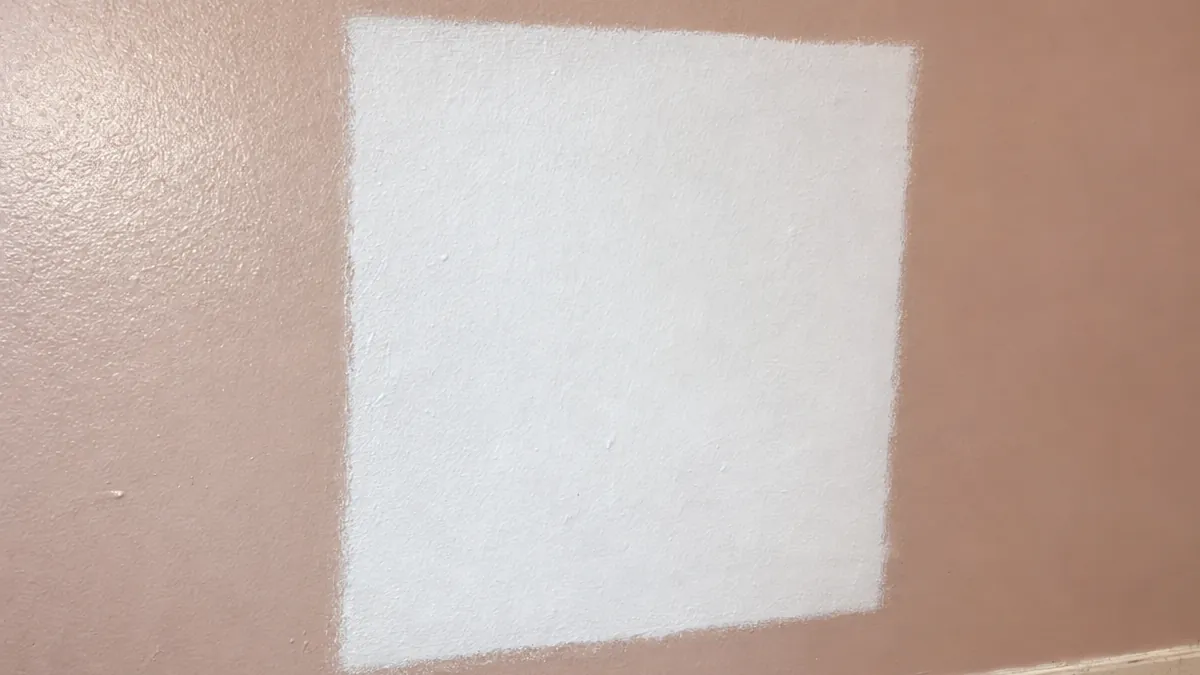
After the repair: primer and paint
Every ceiling patch, like the wall patch pictured above, is primed before paint. Fresh compound and new board drink paint differently from an old painted surface, and without primer the repair shows up as a blotch of different sheen once the top coat dries. Ceiling paint is usually flat for the same reason: it hides small variations in the surface better than any sheen.